
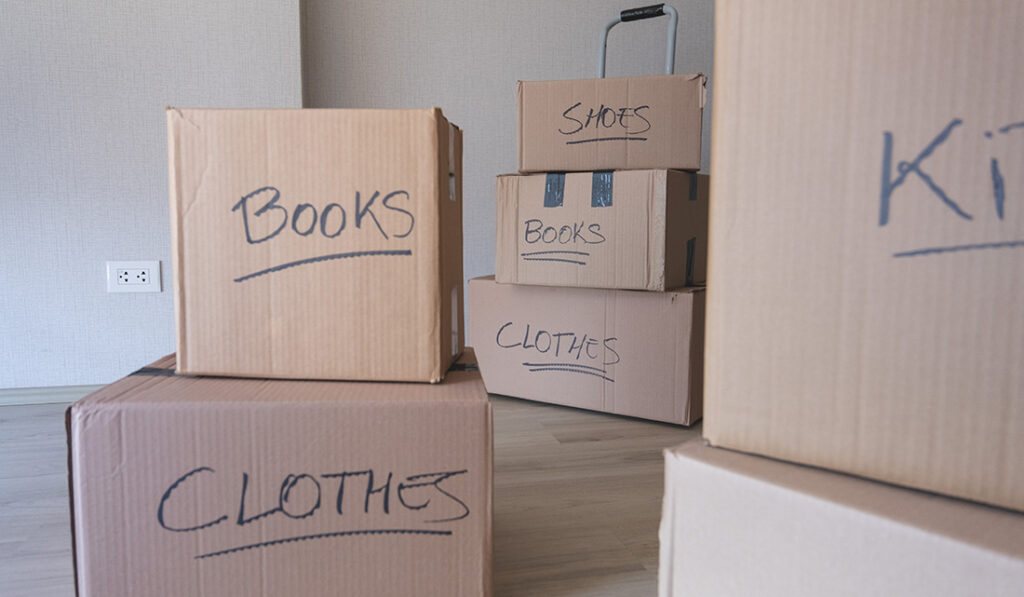
A typical 3-bedroom house needs roughly 50 to 70 boxes for moving, plus a few wardrobe boxes for hanging clothes, though the number varies with how much you own. Sturdy boxes of the same size make packing safer and loading faster.
We’re D&G Moves, a Leeds-based removals company serving households and businesses across Yorkshire. We supply packing materials and a professional packing service, and we’re rated excellent,’ 5 star rated’ on Google Reviews.
It is easy to overbuy, underbuy or choose flimsy boxes. This guide covers where to buy, how many, how to pack and label, and when to hand the job over.
Key takeaways
- Same size: Same sized boxed for all content, no matter of the room.
- Strength matters: Good reliable cardboard boxes for all contents, like books, dishes, electronics etc.
- Count by home size: A 3-bed house needs about 50 to 70 boxes. Order about 80% first, then top up, we can advise when we come round to quote.
- Label every side: With the destination room, contents (if required) and “fragile” where needed.
- Know when to hand over: Professional packing may be worthwhile when time, health or fragile items are the problem.
Where can you buy sturdy boxes for moving in the UK?
You can buy from us and we can drop them off at the time of booking, Alternatively you can buy from DIY chains, online packaging suppliers, marketplaces, removal companies and storage centres. The right source depends on the size of your move. A few extra cartons suit the high street. A full house suits a mixed home-mover pack or a removal company.
Comparing the main sources at a glance
| Source | Best for | Typical packs | Watch out for |
|---|---|---|---|
| DIY and high-street stores (B&Q, Wickes, Homebase, Argos) | A few boxes, same-day collection | Individual boxes, small multipacks such as five-box packs | Stock varies by branch, so check before you travel |
| Online packaging suppliers | Full house moves and bulk orders | Mixed-size and house-size kits, double-wall cartons | Delivery charges and exact box dimensions |
| Marketplaces such as Amazon | Quick multipacks and complete kits | Budget boxes, specialist cartons, moving kits | Strength and sizes differ between sellers |
| D&G Moves | One supplier for boxes, packing and the move | Individual boxes, wardrobe boxes, bubble wrap and strong tape. | Just let us know at the quoting stage to add it in. |
| Free or reused boxes | Light items on a tight budget | Whatever you can find | Mixed sizes, unknown condition |
Always check pack contents, wall strength and delivery charges before you order.
Why buying your moving boxes from us is the simplest option
The people moving you know what the van needs, so we supply strong boxes, wardrobe boxes, bubble wrap and tape, and you don’t piece a kit together from three shops.
Matching boxes are a practical choice for the move itself. Identical boxes stack flat and tight, which makes the load easier to build. Mixed sizes tend to leave gaps, and gaps can lead to shifting.
Can you get free or cheap boxes instead?
Yes, but be selective. Facebook Marketplace and workplaces are all worth a try. Take only boxes that are clean, dry and intact, and avoid any that are contaminated by food or chemicals.
Free boxes have limits. Mixed sizes are hard to stack, so use them for light items. For books, choose small, sturdy cartons, and take particular care with crockery and other fragile items.
Do you need wardrobe boxes?
If you own more than a few hanging items, they are worth considering. A wardrobe box has a hanging rail, so clothes can go from rail to rail with less folding, which helps minimise creasing at the other end.
Plan on one wardrobe box for every 60 cm (about 2 feet) of hanging rail. Measure your rails, add the lengths in centimetres, divide by 60 and round up. A 3-bedroom home typically needs 3 to 6.
How many boxes does your household need?
For a 3-bedroom house, plan on 50 to 70 boxes. Smaller and larger homes scale from there.
A starting estimate by home size – (rough guide)
| Home size | Boxes |
|---|---|
| Studio or bedsit | 10 to 20 |
| 1-bed | 20 to 35 |
| 2-bed | 35 to 50 |
| 3-bed | 50 to 70 |
| 4-bed | 70 to 100+ |
| 5-bed | 100 to 120+ |
When to add extra
As a planning estimate, add 15 to 25% for a full loft, garage or cellar, a big book collection, heavy kitchenware, or many years in the property. Maybe declutter first. It cuts the total faster than any packing trick.
The smart way to order
If you stick to one standard box size, ordering is simpler still: count the boxes, then add wardrobe boxes. Just make sure heavy loads stay liftable in that size. Buy about 80% of your estimate first and top up as you go.
How do you pack and label boxes so nothing breaks?
Build the box properly, pack heavy items low, wrap and fill every gap, and keep each box liftable. Then label it so it lands in the right room. Read our packing guide here for further detail.
Packing step by step
- Build the box and tape the base properly, with a cross as well as the centre seam.
- Put heavy items at the bottom and light items on top.
- Wrap every fragile item separately in bubble wrap or paper, and fill every gap so nothing shifts.
- Keep each box comfortably liftable. Don’t overfill it so the lid bulges.
- Seal it fully.
- Keep heavy boxes at the bottom of stacks in the van and the house.
What should you write on every box?
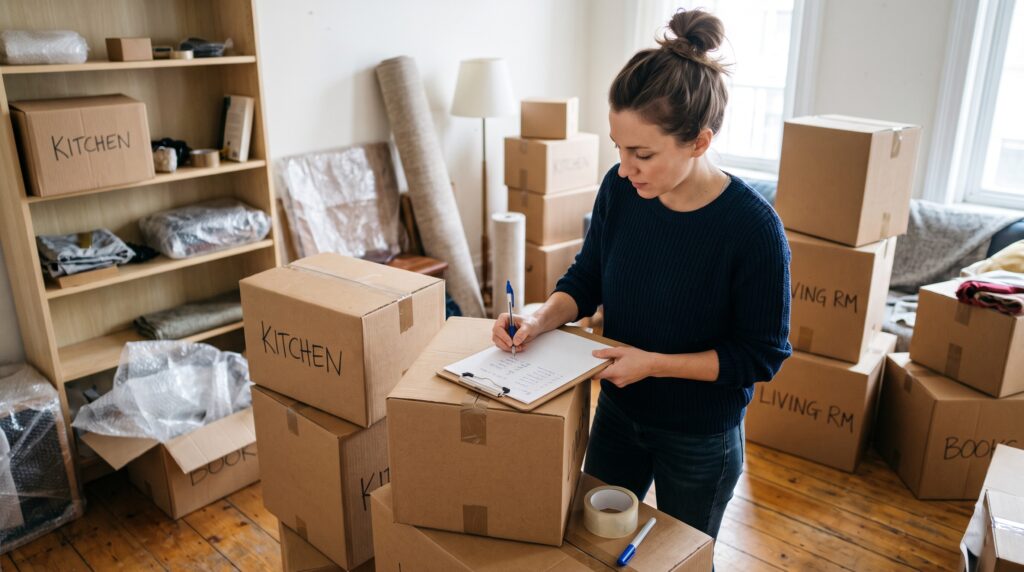
Write the room name the box is going to, a short contents note and “fragile” where needed. Label the sides, not just the top, because boxes get stacked and a top label disappears.
Pack an “open first” box too: kettle, tea bags, coffee, phone chargers, pet food, snacks, a loo roll, maybe some medications, bedding and tools. You’ll want all of it on the first night. It’s always a good idea to take this box yourself in your car so you’re not waiting for it to be unloaded from the removal van.
Need a hand if you’re packing yourself?
Just ask. If the packing is the part you dread, our team can take it off your plate. We handle packing as part of a fully managed move, with a full-time, insured and trained team. Read more here about our packing service and estimated costs.
When is professional packing worth paying for?
When time, health or fragile belongings make doing it yourself the riskier choice. Not every move needs it. A small flat with a free weekend and a patient friend may not.
Situations where it may be worthwhile
It can be worthwhile with a tight timeline, a big house or a full loft, with fragile or valuable items, or when family commitments or health and mobility limits get in the way. If the move is already stressful, packing is the easiest job to hand over.
A professional packer may work faster and wrap more carefully, which can help reduce breakages, though results depend on the packer and the circumstances. We can also just pack your fragile items and art if required and you pack the smaller items. It’s never all or nothing we can help in a number of ways to suit yourself.
It might be you have neurodivergent children who are worrying about the move and packing everything they know into boxes will make the run up to the house move a worrying time for you as parents, this is when our day-before-packing-services really comes into it’s own. Read our Neurodivergent Moving Checklist here.
How D&G Moves packs for you
We bring the boxes, wardrobe boxes, bubble wrap and tape, and our team does the packing the day before the move.
This way you are not living out of boxes for weeks before the move, it’s just the day/night before.
We handle every stage of a move: planning, packing, loading, transport and unloading. We also offer secure storage, furniture dismantling and waste removal if you need them.
Packing yourself, or a mix of both?
You decide how much to hand over. Tell our team what you’d like and we’ll quote for it.
We charge no upfront deposit, no cancellation fees, no waiting fees and no hidden extras.
If you’d like a quote, call us on 0113 531 5333 or email info@dandgmoves.co.uk and click here and complete the form and either Alistair or Callum will give you call.